Vaping and Oral Cancer: What Dental Professionals Should Know
Sep 22, 2026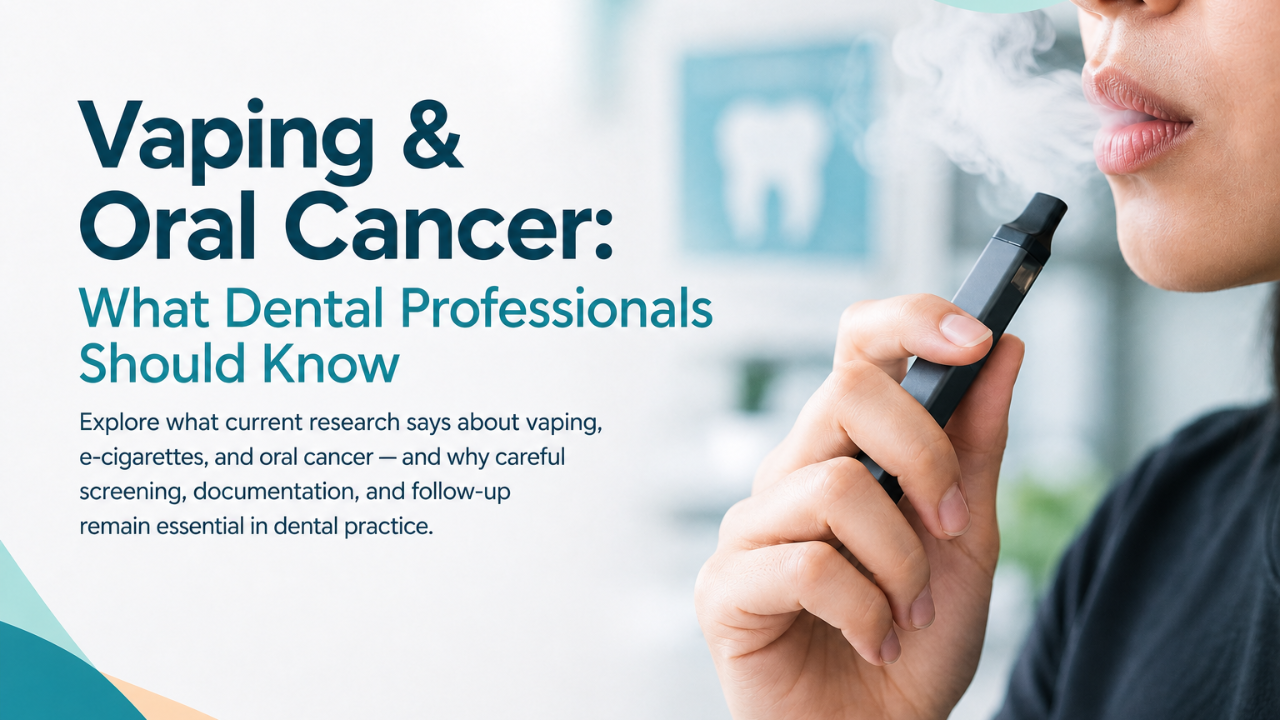
Vaping and Oral Cancer: What Dental Professionals Should Know
Vaping and e-cigarette use have become increasingly common, but what do we actually know about their potential effects on oral health and oral cancer?
For dental professionals, the answer is not as simple as saying that vaping causes oral cancer. Research is still developing, particularly when it comes to the long-term effects of e-cigarette exposure on oral tissues.
What we do know is that the oral cavity is directly exposed to e-cigarette aerosols, and researchers have identified biological changes that deserve continued attention.
What Does the Research Tell Us?
A 2020 review examined the potential oral carcinogenic effects of e-cigarettes using the Bradford Hill criteria, a framework commonly used to evaluate whether an observed association may represent a causal relationship.
The researchers discussed findings from experimental studies showing that exposure to e-cigarette vapor can produce cellular and molecular changes in oral tissues, including DNA damage and changes involving pathways associated with carcinogenesis.
However, the authors also emphasized an important limitation: there was not enough long-term, large-scale human evidence to establish e-cigarette use as an independent cause of oral cancer.
This distinction matters.
A potential biological effect is not the same thing as proof of cancer causation.
Research published since then continues to describe concerning biological effects while also emphasizing that more long-term human studies are needed to fully understand the relationship between vaping and oral cancer.
Why Should Dental Professionals Pay Attention?
Even when the long-term cancer risk remains uncertain, vaping is relevant to the dental setting.
The mouth is one of the first areas exposed to e-cigarette aerosol. Researchers have investigated potential effects involving oral cells, inflammation, the oral microbiome, and other aspects of oral health.
For dental professionals, this creates an opportunity to ask better questions during the medical and dental history and to document relevant patient habits.
More importantly, it reinforces the value of careful oral examination.
A patient's vaping history should not be used to automatically label a lesion as cancer. Instead, clinicians should evaluate the lesion itself, consider the patient's complete history and risk factors, document findings appropriately, monitor changes when indicated, and determine when referral or further evaluation is warranted.
Look Beyond a Single Risk Factor
Oral cancer risk is complex.
A patient may have multiple potential risk factors, including tobacco and alcohol exposure, age, certain infections, and other individual factors. In patients who vape, conventional cigarette smoking or other exposures may also make it difficult to determine whether vaping itself is responsible for a particular outcome.
That's why oral cancer screening should focus on recognizing clinical findings rather than relying on a single risk factor.
What Should You Look For?
During an oral examination, clinicians should pay attention to changes such as:
-
Persistent red, white, or mixed red-and-white lesions
-
Ulcers that do not resolve as expected
-
Unexplained lumps or tissue changes
-
Areas that change in appearance over time
-
Unexplained bleeding or other persistent abnormalities
-
Changes that warrant monitoring, additional investigation, or referral
The presence of one of these findings does not automatically mean cancer.
The important step is knowing what deserves closer attention and having a consistent process for documenting, evaluating, monitoring, and referring suspicious findings.
Screening Is About More Than Finding a Lesion
An effective oral cancer screening process involves more than simply looking inside the mouth.
It can include:
Recognizing — identifying changes that may require further attention.
Documenting — recording what you see so changes can be evaluated over time.
Evaluating — considering the lesion, patient history, risk factors, and clinical presentation.
Referring — knowing when additional evaluation or specialist input is appropriate.
Following up — ensuring concerning findings do not simply disappear from the patient's record.
These steps can help make oral cancer screening a more consistent part of everyday dental care.
Want to Strengthen Your Oral Cancer Screening Approach?
If you're a dental professional looking to become more confident in recognizing suspicious oral lesions, documenting findings, and understanding when further evaluation may be appropriate, continuing education can help turn awareness into a more structured clinical approach.
Beyond Red & White Lesions: A Guide to Oral Cancer
Explore our educational course designed to help dental professionals strengthen their approach to oral lesion recognition, screening, documentation, and clinical decision-making.
Start With the Oral Cancer Self-Assessment
Not sure where your current oral cancer screening approach stands?
Take the Dua Good Job Oral Cancer Self-Assessment to identify areas where you may want to strengthen your knowledge and clinical approach.
Take the Oral Cancer Self-Assessment →
Continue Your Clinical Training
For dental professionals who want to go further, our oral biopsy education provides practical training focused on biopsy techniques and oral lesion management.
Explore the Oral Biopsy Course →
The Bottom Line
Research into vaping and oral cancer is still evolving.
Current evidence raises legitimate questions about the potential biological effects of e-cigarette exposure on oral tissues, but it is important not to overstate the evidence. Current research does not establish vaping alone as an independent cause of oral cancer, and more long-term human research is needed.
For dental professionals, the practical takeaway is straightforward:
Stay informed. Ask about vaping and tobacco use. Examine carefully. Document changes. And know when a finding deserves further evaluation.
Research Source
Raj AT, Sujatha G, Muruganandhan J, et al. Reviewing the oral carcinogenic potential of E-cigarettes using the Bradford Hill criteria of causation. Translational Cancer Research. 2020;9(4):3142-3152. doi:10.21037/tcr.2020.01.23.
Read the full research article on PubMed/PMC →
Educational disclaimer: This article is intended for educational purposes and does not constitute medical or dental advice, diagnosis, or treatment. Clinical decisions should be based on the individual patient and appropriate professional evaluation.
Stay connected with news and updates!
Join our mailing list to receive the latest news and updates from our team.
Don't worry, your information will not be shared.
We hate SPAM. We will never sell your information, for any reason.